Most blockchains change slowly. Upgrades can take years of debate, and the people who hold the tokens rarely get a direct say. Cardano has taken a different route. Its community now proposes and votes on changes on-chain, and one organisation sits in the middle of that process, helping ideas turn into decisions.
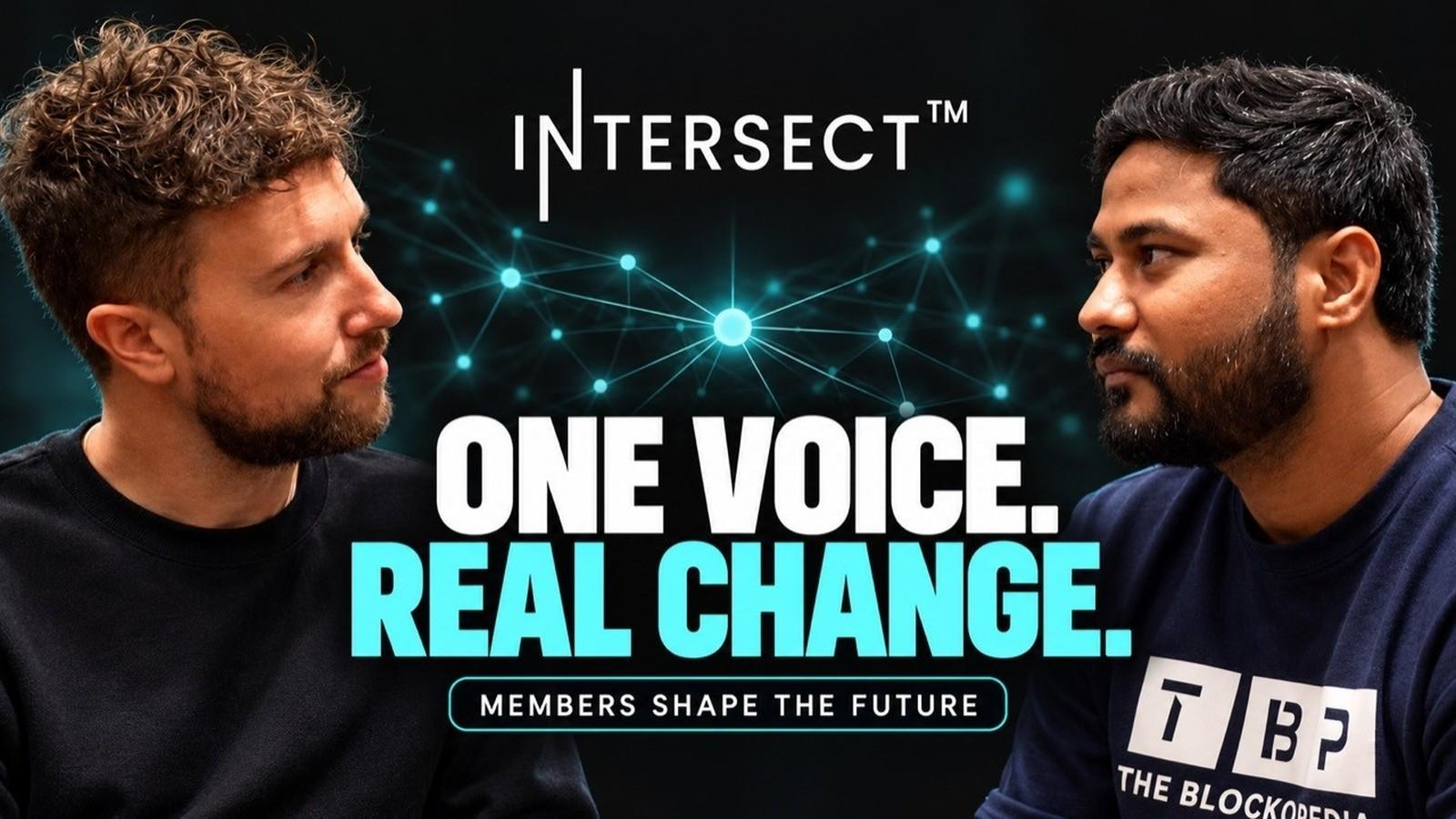
On the sidelines of Token2049 in Singapore, Mohammad Ahmad Khan, co-founder of The Blockopedia, sat down with Jack Briggs, Executive Director of Intersect, for the TBP Podcast. Intersect is the member-based organisation that coordinates decision-making for the Cardano ecosystem. In a 10-minute conversation, Jack explained why he chose Cardano, how a proposal moves through Intersect, how builders can get funding, how he went from buying his first Bitcoin in 2012 to leading Intersect, and where he sees the next wave of innovation.
Key Takeaways
- Intersect is a member-based organisation that helps Cardano make decisions. Members find a problem, propose a solution to the ecosystem, the community votes, and then the change is made.
- By Jack’s estimate, Intersect has proposed about 80% of all the votes Cardano has taken. Its elected expert committees help ideas win wider support.
- Cardano is permissionless, so anyone can propose a change. Jack says one community member pushed a major change through last year, which shows a single voice can still matter.
- Builders on Cardano are funded through the on-chain treasury, outside capital or their own money. No permission is needed to build, and Intersect and the founding entities can offer extra support.
- Jack says Cardano is “catching up” from a position of strength, pointing to new integrations such as LayerZero and Fireblocks and to the chain’s record on security.
- He believes the same tools could make government more transparent, and names AI agents, DeFi and privacy, including the Midnight network, as the main areas of innovation.
Why Cardano? Academic rigour and security
The first question was the simplest one: why Cardano? Jack points to how the network was built. For him, the core reason for its success is “its academic rigour and how it was built in the first place.”
He describes Cardano as one of the longest-standing blockchains, one of the “legacy” layer 1 networks from 2017 and 2018. It is, he says, “still very much alive and kicking and importantly safe and secure.”
That matters more now, he argues. With the rise of AI and problems hitting many different protocols, Jack says Cardano is holding itself above the rest on security and resilience.
His second reason is what developers can do on the chain. “The programmability of it is immense and deep,” he says.
What Intersect does for Cardano
Jack is direct about how he sees his organisation. “Intersect is a very unique company,” he says. “It’s probably actually unique in the whole of the industry. There’s not a company quite like us anywhere else.”
Its job, in his words, is to “help coordinate decision-making.” Intersect is a member-based organisation. Members join, and those members bring forward ideas for the rest of the ecosystem to consider and vote on.
Intersect launched in July 2023 as a member-based organisation to steward Cardano’s development, according to Input Output’s timeline of Cardano governance. Since the Chang upgrade in September 2024, Cardano has run on-chain governance. Cardano Docs says any ada holder can now submit or vote on governance actions, either directly or by delegating to representatives known as DReps.
Jack contrasts this with older networks. Because Cardano’s community can find consensus together quickly, vote and then act, he says it can move faster than Bitcoin or Ethereum on big questions. “Cardano can move at light speed with big decisions,” he says. He calls that “massively important” for how the network keeps advancing, “especially in the age of AI.”
How a proposal moves through Intersect
Jack describes the basic loop in a few steps:
1. Members join Intersect.
2. They find a problem.
3. They find a solution.
4. They propose it to the rest of the ecosystem.
5. The community votes.
6. If the vote passes, the change is made.
“And that can happen pretty quickly, actually,” he says.
Ahmad asks for a real example of a decision that would not have been possible without Intersect. Jack starts with a key point about Cardano: it is permissionless. “Anyone can suggest anything and it can happen,” he says. “The challenge is when you build consensus so that people support that idea.”
That is where Intersect plays its biggest role. By Jack’s estimate, Intersect has proposed about 80% of all the votes Cardano has taken. Part of the reason is expertise. Intersect has elected committees, and their members typically have backgrounds in technology, growth, adoption or utility.
Proposals that come from these experts tend to win more consensus, he says. Voters like the fact that “someone else has looked at this” and that “it’s not just some one person’s idea.”
Yet the system does not lock out individuals. Jack says one community member proposed “a massive change to the ecosystem” last year, and it went through. He did not name the proposal in the interview. For him, that is the point. An institution like Intersect can help many decisions through, while “one person with one voice and a bit of grit can make a change as well.”
“And that’s just the beauty of Cardano,” he adds.
Advice for builders: funding and support
Asked what builders should know if they want approval in the Cardano ecosystem, Jack is open that this is “probably a challenge that we are still working through.”
Today, he says, Cardano builders fund their work in one of three ways:
- the Cardano treasury, which he calls one of Cardano’s “big USPs”
- external capital raised elsewhere
- their own money
There are no gatekeepers. “You don’t need permission to build on Cardano, anyone can,” Jack says. Builders who want more institutional backing can turn to Cardano’s founding entities or to Intersect. But he stresses that there are “no rules” and “no criteria” to build on Cardano, which he sees as “really important” so that anyone can come.
The bigger question for Cardano, Jack says, is how it attracts builders, and that is where governance has changed things. He points to LayerZero and Fireblocks coming on board. “Cardano is very much catching up,” he says. “And when I say catching up, we’re catching up from a position of strength.”
His case rests on the same strengths he named earlier: academic rigour, security and a resilient chain. Builders want to build there, he says, because they know their smart contracts “are going to be deployed safely and they’re going to work.”
Both integrations are on public record. LayerZero, a protocol that lets blockchains pass messages and assets to each other, went live on Cardano in March 2026, connecting it to more than 160 other chains, according to TapTools. The integration came through a Critical Infrastructure proposal backed by the Cardano “Pentad”: the Cardano Foundation, Input Output Global, EMURGO, Intersect and the Midnight Foundation.
In September 2026, the Cardano Foundation and Fireblocks also announced that Cardano Native Tokens will be fully supported on the Fireblocks platform, with support expected by March 2027. Fireblocks has supported ADA itself since 2021, according to the Cardano Foundation.
From a £52 Bitcoin to leading Intersect
Ahmad then turns to Jack’s own story. Jack got into Bitcoin in 2012, out of simple curiosity. “I spent 52 pounds, I think, on my first Bitcoin,” he recalls. He says he moved into Ethereum around 2015 or 2016, and Cardano “came quite naturally afterwards.”
His route into Cardano work came through an offer from one of its founding entities, the one led by Charles Hoskinson. The task was to help shape the future of Cardano, and to work out how to coordinate an ecosystem as decentralised and global as Cardano.
His LinkedIn profile shows that he led product marketing for Cardano’s governance era at Input Output from late 2021. He joined Intersect as Ecosystem Director in January 2024 and became its Executive Director in 2025. Before crypto, he worked in marketing for firms including Vodafone and Thomson Reuters.
The role felt natural, he says, because of where he came from. London, in his words, is “a well-established democracy, but like all democracies has problems.” Jack was frustrated with the issues he saw locally in London and nationally in the UK.
He wanted “a different way of how do we govern ourselves,” and a way to make decisions “more transparently, more openly together.” He also wanted to stop relying on information from an institution he does not trust.
“I don’t need to trust, I can verify myself,” he says, calling that the whole point of blockchain.
That thinking drew him to Intersect. He helped build it, incubate it and launch it. Now he runs it.
Can Cardano’s model work for governments?
Ahmad asks how the system Jack has helped build on Cardano could work in real life. Jack, who now lives in Spain, starts with his own paperwork. Every time he renews a licence or a permit, he says, “I have to sit in a room for 6 hours.” He describes being sent from room to room, then finding out he has missed something and needs another stamp.
He believes blockchain is ready to change national infrastructure, and says it “just makes no sense why we don’t do it.” His case is about money and openness. It would save taxpayers a great deal of money, he argues, and it would bring transparency.
“I want to know where my taxpayer money is being spent, and I want to know how decisions are being made,” he says. In his view, that is missing in national governments everywhere, and no country is an exception. “India is the same, US has problems, we’re all the same,” he says.
Where Jack sees the innovation: AI agents, DeFi and privacy
Ahmad’s last question asks for two pieces of advice for builders: where to go, and what to be cautious about, given that Jack has seen several market cycles. Jack’s answer focuses on the opportunities. He does not name areas to avoid.
He starts with agentic AI, while admitting “that’s the buzzword now.” His main pick, though, is DeFi. “DeFi is where the innovation, the financial innovation really is,” he says.
When traditional finance looks at blockchain and asks where new ideas in finance are coming from, the answer, he says, is DeFi. That is why the industry is seeing more TradFi interest, and he argues it is about more than liquidity or yield opportunities.
“You can get lost in DeFi and come out like, ‘Wow, I didn’t know this was even possible,'” he says. What excites him most is doing it on his own terms. “I don’t have to ask permission to do something.”
His second pick is privacy, which he expects to be “a massive play.” He credits Zcash for doing well and pioneering the area. On Cardano, he points to Midnight. He calls it “the biggest project I would argue on Cardano at the moment” and a privacy play that everyone “should be excited about and all should care about as well.”
Midnight is a privacy-focused network in the Cardano ecosystem that uses zero-knowledge proofs. According to the Midnight Network blog, its mainnet was set for late March 2026, starting with federated node operators that include Google Cloud and Blockdaemon.
Final thoughts
The interview makes one point clearly: on Cardano, governance is not a side feature but the way the network moves. Jack describes Intersect as an organisation that helps members turn problems into proposals and builds expert-backed consensus, while still leaving room for a single member with “a bit of grit” to change things.
Some of what he says is fact and some is opinion or forecast. The LayerZero and Fireblocks integrations are on record. The 80% share of votes is Jack’s own estimate, and his views on government use, DeFi and privacy are predictions, not outcomes. He is also candid that support for builders is still being worked out.
Watch the full conversation on the TBP Podcast YouTube channel.
Frequently Asked Questions
Q: What is Intersect in the Cardano ecosystem?
Intersect is a member-based organisation that helps coordinate decision-making for Cardano. Members bring forward problems and solutions, propose them to the wider ecosystem, and the community votes. It launched in July 2023, according to Input Output.
Q: Who is Jack Briggs?
Jack Briggs is the Executive Director of Intersect. He got into Bitcoin in 2012, later worked on Cardano governance at Input Output, and helped incubate and launch Intersect before taking the top role.
Q: How does a proposal pass in Cardano governance?
Anyone can suggest a change because Cardano is permissionless. The proposal is put to the ecosystem and voted on. Jack says Intersect, supported by its elected expert committees, has proposed about 80% of all the votes Cardano has taken.
Q: Can one person change Cardano?
Jack says yes. According to him, one community member proposed a large change to the ecosystem last year, and it went through. Building consensus is the hard part, he adds.
Q: How do builders get funding on Cardano?
Jack says builders use the Cardano treasury, external capital or their own funds. No permission is needed to build. Intersect and Cardano’s founding entities can offer more institutional support.
Q: What is Midnight on Cardano?
Midnight is a privacy-focused network in the Cardano ecosystem that uses zero-knowledge proofs. Jack calls it arguably the biggest project on Cardano right now. This is an industry view, not investment advice – crypto assets are volatile and can lose value.